
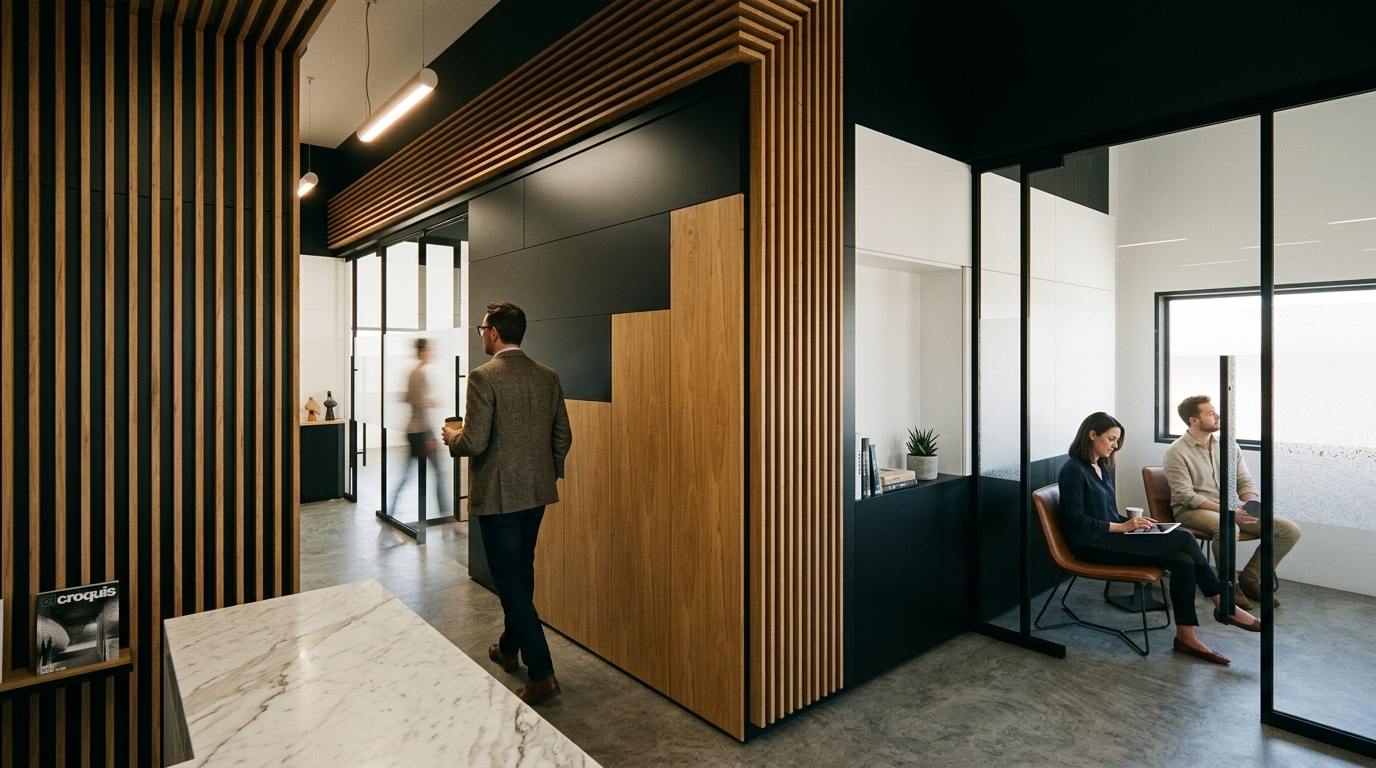
Speed and reliability shouldn’t be a trade-off in construction.
Project teams are under increasing pressure to move faster while still delivering quality, maintaining design intent, and keeping schedules predictable.
Yet traditional commercial interior construction can make that difficult. Design, coordination, fabrication, and installation often happen across different teams and systems, allowing questions and conflicts to remain unresolved until construction is underway.
According to McKinsey’s 2024 research, global construction productivity improved by only 10% between 2000 and 2022, compared with 90% in manufacturing.
Building faster isn’t simply about working faster. It requires improving the process itself. That’s where Digital Component Construction (DCC) comes in.
What Is Digital Component Construction?
Digital Component Construction (DCC) is a construction methodology pioneered by Mogens Smed and Barrie Loberg, co-founders of Falkbuilt. Intriguingly enough, DCC isn’t about replacing everything the construction industry already knows.
We’re evolving the process of construction, not reinventing it.
The fundamentals of building remain familiar. What changes is how, and when, design, coordination, manufacturing, and installation connect within the process.
Instead of relying on separate stages and repeated handoffs, project information moves through a shared digital workflow.
Details can be coordinated and validated earlier → components can be precision-manufactured off-site → installation teams receive materials prepared for the coordinated design.

The goal isn’t to make construction unfamiliar. It’s to make the familiar process more efficient, more predictable, and ultimately more reliable.
And while prefabrication is part of DCC, it’s only part of the story.
How Is Digital Component Construction Different From Modular Construction?
For some architects and designers, the word “prefab” immediately brings modular construction to mind: standardized components, predetermined layouts, and limitations on creative freedom.
It’s an understandable association, as some prefabricated approaches can raise concerns about bespoke designs, unique site conditions, and transportation or assembly constraints.
But prefabrication doesn’t have to mean compromising design intent for construction efficiency.
As off-site construction evolves, McKinsey’s 2025 research examines how advances in digital technology and manufacturing are enabling greater customization within modular construction, one form of prefabrication.
Digital Component Construction is not modular construction.
Rather than manufacturing complete volumetric modules or requiring designs to conform to predetermined configurations, DCC prefabricates individual components based on digitally coordinated, project-specific information.
Those components are precision-manufactured off-site, efficiently packaged for transportation, and assembled on-site using familiar construction methods.
This approach combines the efficiencies of prefabrication with the flexibility to accommodate different layouts, architectural details, and existing building conditions.
The goal is to preserve design flexibility while improving how it gets built.
How Does Digital Component Construction Improve Construction Speed?
Construction speed isn’t simply measured by installation. It’s also influenced by what happens before it begins. When trades coordinate earlier, details are resolved sooner, and components are manufactured off-site, less work needs to be completed from scratch in the field.
Components arrive prepared for installation, reducing activities such as on-site cutting and material handling while helping minimize construction waste and jobsite disruption.
For occupied commercial environments, where construction activity can interfere with daily operations, that difference can be particularly valuable.
But the ability to move faster only matters if the process remains reliable.
How Does Digital Component Construction Improve Construction Reliability?
Reliability in construction starts with reducing uncertainty before installation begins. That requires more than accurate manufacturing. It requires consistent project information, coordinated decisions, and a team capable of carrying those decisions through execution.
Construction projects involve an enormous amount of information, and that information doesn’t always live in one place.
Autodesk’s 2025 State of Design & Make research found that only 38% of surveyed construction leaders rated their organizations’ ability to share data as strong.
When teams rely on disconnected sources of information, maintaining consistency becomes more difficult.
This is where Echo, Falkbuilt’s cloud-based technology platform, becomes an important part of DCC. Working alongside industry-standard software such as Revit, Echo helps connect project information within a shared digital environment. Teams can visualize spaces in 3D, review how systems interact, and validate key details before components are manufactured.
Consider a glass office front that needs to align with ceilings, doors, integrated technology, and existing building conditions. Instead of waiting until installation to understand how those elements come together, teams can review their relationships earlier in the digital model.
Once those details are coordinated, the information informs precision manufacturing, helping maintain consistency between what was designed and what arrives on-site.
But technology alone doesn’t create reliability.
It also depends on the people managing the process.
At FalkbuiltNY, our team works alongside architects, contractors, designers, and owners to coordinate project requirements and support delivery through installation.
Together, digital coordination, manufacturing precision, and project support create a more predictable construction process.
That doesn’t mean every unexpected condition disappears.
It means project teams have more opportunities to identify potential conflicts, manage changes, and address important details before they become physical jobsite problems.
What Does DCC Mean for Commercial Interior Projects?
The benefits of Digital Component Construction extend beyond the prefabricated components themselves.
For architects and designers, it can mean greater confidence that design details carry through to execution. For general contractors and project managers, it can mean fewer unknowns and less on-site complexity. For owners and developers, it can mean greater confidence in project schedules and the path toward completion.
The common advantage is a construction process designed to improve efficiency without sacrificing design flexibility or reliability.
A Faster, More Reliable Way to Build
Digital Component Construction isn’t about removing complexity from construction altogether. It’s about managing that complexity differently.
By connecting digital coordination, off-site manufacturing, and on-site installation, DCC helps project teams move more efficiently while creating greater visibility and predictability throughout the process.
At FalkbuiltNY, we bring that methodology to commercial interior projects through prefabricated interior solutions supported by technology and experienced project teams.
Because building faster shouldn’t mean sacrificing reliability.
Interested in seeing how Digital Component Construction could support your next project? Connect with the FalkbuiltNY team to explore our process and prefabricated interior solutions.